

Professor Zhang Ping's Research Team from the School of Resources and Environment Publishes Achievements in Water Treatment Catalysis in Wat
发布时间:2026-03-24
Recently, researchers from the School of Resources and Environment and the Key Laboratory of Poyang Lake Resource and Environment Utilization of the Ministry of Education, Nanchang University (as the first affiliated institution), led by Professor Zhang Ping as the first author, have published a research paper titled Atomically Engineered Fe/Mn Catalysts Enable Ultrafast Self-Sustaining Water Purification via Oxidant-Free Fenton-like Electron-Transfer Reaction in Water Research, a top-tier academic journal in the environmental field.
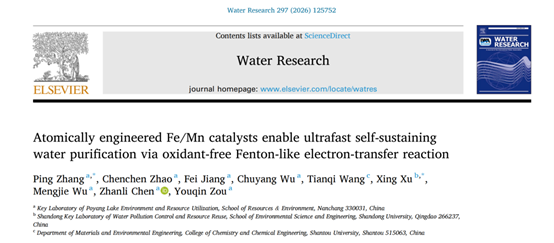
In this study, an Fe/Mn synergistic catalytic system was constructed through an atomic-level engineering strategy. The research revealed the self-sustaining water purification mechanism driven by oxidant-free Fenton-like electron transfer reactions and realized the ultrafast degradation of pollutants. It provides a novel theoretical foundation and technical approach for the development of green and low-carbon water treatment technologies.
Figure 1
The innovative highlights of this research are mainly reflected in three aspects. First is material innovation: a "cluster-satellite" structure integrating Fe nanoclusters (~0.8 nm) and Mn single atoms (interspace ~0.51 nm) was successfully constructed. This breakthrough overcomes the limitation of insufficient electron supply in single-metal systems and establishes a new paradigm for atomic-level synergistic catalysis. Second is mechanism clarification: multi-dimensional characterization methods confirmed the non-radical pathway dominated by direct electron transfer. It was found that Mn single atoms enhance the electron acceptance capacity of Fe by 1.6 times through the dual effects of "static regulation and dynamic inertia", offering a brand-new theoretical perspective for the bimetallic synergistic mechanism. Third is performance breakthrough: the removal efficiency of BPA exceeded 99.5% within 3 minutes without any oxidant addition, setting a new rate record for self-sustaining systems. In the continuous-flow treatment of 10,000 mL real water bodies, the removal rate remained above 94.43%. Mild regeneration tests and life cycle assessment verified its advantages in large-scale application and environmental sustainability, setting a new benchmark for the next generation of green water treatment technologies.
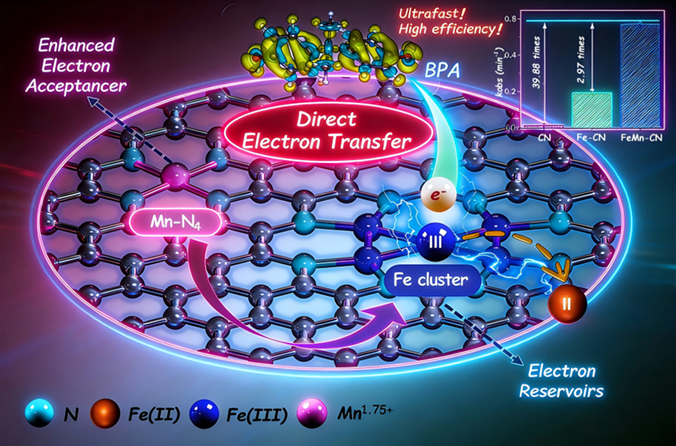
Figure 2
In this work, an FeMn-CN catalyst with a "cluster-satellite" structure containing both Fe nanoclusters and Mn single atoms was successfully fabricated via atomic-level engineering, achieving ultrafast degradation of BPA within 3 minutes (removal efficiency >99.5%) under oxidant-free conditions.
Quenching experiments, EPR characterization, in-situ spectroscopy, XAFS analysis and DFT calculations systematically excluded the participation of free radicals, singlet oxygen and high-valent metal species, confirming that direct electron transfer serves as the dominant mechanism. Specifically, Fe nanoclusters act as electron acceptors to extract electrons directly from pollutants, while adjacent Mn single atoms reduce the energy barrier to synergistically improve electron transfer efficiency.
The catalyst exhibits wide pH tolerance, strong anti-interference ability, and selective recognition toward electron-rich pollutants. Continuous-flow reactors validated its potential for large-scale practical application, and life cycle assessment further proved its environmental sustainability. This study proposes atomic-level design principles for electron transfer-dominated self-sustaining catalysts and promotes the advancement of oxidant-free water purification technologies.
This research was supported by the National Natural Science Foundation of China, the Key Research and Development "Listed Project" of Jiangxi Province, the Major Special Project for Key Agricultural Technologies of Jiangxi Province, the Key Program of the Natural Science Foundation of Jiangxi Province, and other funding projects.
The School will continue to focus on national ecological civilization construction and the "dual carbon" strategic needs, deepen industry-university-research collaborative innovation, strive to produce a number of influential landmark research achievements, and contribute more wisdom and strength to the "Double First-Class" construction of the university and the regional green low-carbon development.
Author Introduction
First Author
Zhang Ping
Professor & Doctoral Supervisor, School of Resources and Environment, Nanchang University.
Her research focuses on the fabrication of environmental functional materials for water pollution control and the high-value resource utilization of agricultural wastes. She has been selected into the training programs of Academic and Technical Leaders of Major Disciplines in Jiangxi Province and Outstanding Young Talents of Jiangxi Province.
She currently serves as Director of the Mineral Materials Branch of The Chinese Ceramic Society, Member of the Mineral Functional Materials Committee of The Nonferrous Metals Society of China, Distinguished Expert of the Jiangxi Provincial Pig Industry Technology System, Academic Editor of Journal of Nanchang University (Natural Science), and Youth Editorial Board Member of Industrial Water Treatment and Journal of Nanchang University (Engineering Edition).
Since joining Nanchang University at the end of 2011, she has presided over 3 National Natural Science Foundation projects, 1 sub-project of the major "Green Manufacturing" project of MIIT of China, 2 China Postdoctoral Science Foundation projects, and more than 20 provincial and ministerial research projects including the Key Research and Development "Listed Project" of Jiangxi Province, the Key Program of Jiangxi Natural Science Foundation and the Major Special Project of Jiangxi Agricultural Technology. She has also participated in 2 national major science and technology projects of the 13th Five-Year Plan: Major Science and Technology Program for Water Pollution Control and Treatment as a core member.
As the first author and corresponding author, she has published over 50 SCI papers in top international journals including Water Research, Chemical Engineering Journal, Journal of Hazardous Materials and Applied Clay Science, among which 31 are in Q1 journals and 15 have an impact factor higher than 10. She has also published more than 30 EI and core domestic academic papers. Additionally, she has applied for 18 national patents, including 4 authorized invention patents.
In the field of agricultural waste resource utilization, the pig manure-based hydrothermal carbon fertilizer technology for red soil improvement and the integrated "synthesis-purification" water treatment system for synergistic nitrogen and phosphorus recovery from breeding wastewater developed by her team have been demonstrated and promoted in multiple pig breeding enterprises in Nanchang, Fuzhou and Ganzhou of Jiangxi Province, achieving excellent environmental and economic benefits.

 0791-83969583